
Av 6, 5784 · 10th August 2024
Parashat Devarim
A D'var Torah by Ben Eaton
"The arc of the moral universe is long, but it bends towards justice" is a phrase popularised by Martin Luther King Jr (although originally thought to have been coined by Theodore Parker - an abolitionist unitarian minister).
It suggests that if we strive for what is right, then even with the many setbacks along the way, justice will prevail. Parshat Shofetim (Devarim, Ch16v20) commands us "Justice, justice, shall you pursue, that you may live and possess the land the Lord, your G-d, is giving you". The commandment doesn't guarantee that we will live to see justice, but we must pursue it nonetheless.
However, that doesn't really relate to today's parsha. Rather, I want to talk about the pernicious (nay, perverse) alternative available to the modern political activist: "the right side of history". This is the belief, borne of a moral certitude, that history will judge your actions to be correct - that in the end, you will be proven right. Consider, for a moment, the level of hubris required to sustain this belief. The idea that you can see the ultimate consequences of your actions, to the point that you can be sure the end will justify the means and history will judge you favourably. To be so full of your own ego, that you think this even matters.
We are Birmingham Progressive Synagogue. The very notion of being "progressive" is predicated on the assumption that we can always improve things, but we don't know how until the opportunity arises or new ideas come about. What's considered "progressive" today may not be thought of that way tomorrow. Judging the past on today's fashions is a great way to repeat mistakes. If we were truly certain of the past, present, and future then there would be no need for progress.
The Jewish response to phrases like "the right side of history" is well summed up in the words of JK Rowling. When asked if she was concerned about how expressing her beliefs would affect her legacy, she said: "I do not walk around my house, thinking about my legacy...what a pompous way to live your life walking around thinking, 'What will my legacy be?' Whatever, I'll be dead. I care about now. I care about the living."
There is a Talmudic precedent for this. When Rabbi Yochanan ben Zakai lay on his deathbed, he wept. When his disciples inquired why he was crying, Rabbi Yochanan replied: "I see two paths before me…and I do not know down which path they will lead me. Should I not weep?". This episode evokes the question, why did he wait until he lay upon his deathbed to question the trajectory of his life? One explanation is that instead of constantly asking himself, "Where am I headed?", Rabbi Yochanan asked, "What does G-d want from me at this moment?"
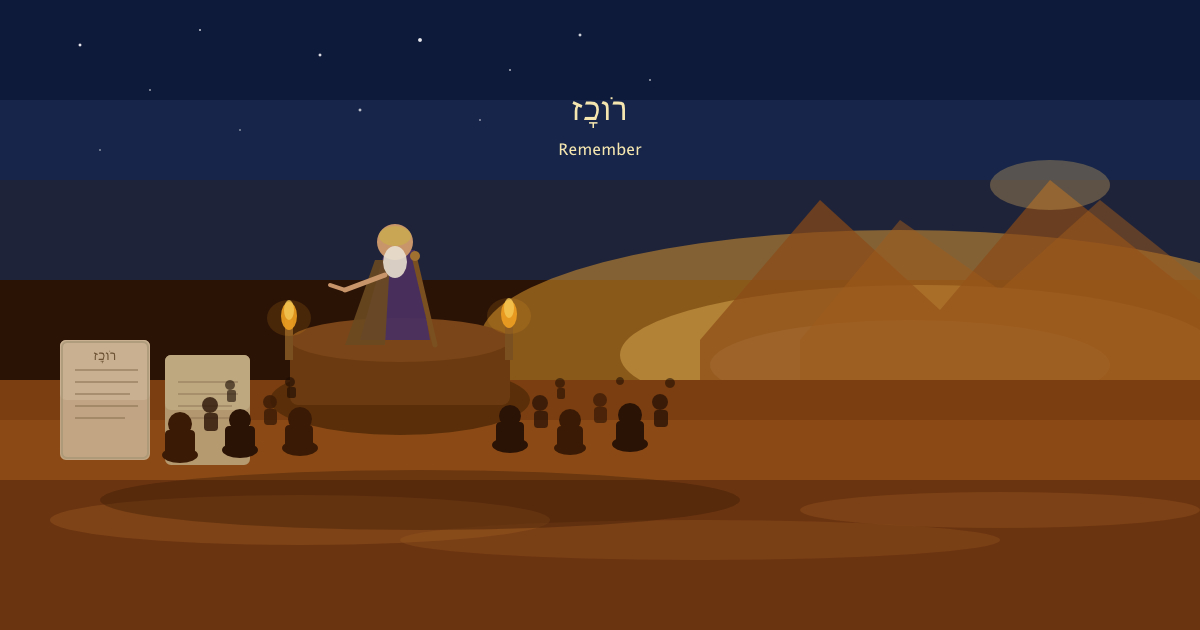
This is an attitude shared with Moses. He's not lecturing us for the whole of Devarim because he wants us to remember him well - he's doing it because he doesn't want us to go astray. He knows he will be leaving us before we enter The Promised Land and he knows we've messed up in the past, so he wants to prepare us for what is to come after he has gone - an essential part of which is reminding us how we got here.
The Commandment to Remember
Judaism places a lot of emphasis on remembering:
"Remember the Sabbath day and keep it holy"
"Remember that you were a slave in the land of Egypt"
"Remember what Amalek did to you on your journey"
It's an active instruction - that means we have to do something to remember. To constantly remind ourselves of the commandments. On Shabbat we cease from work, light candles, and make Kiddush - we do this every week so that we do not forget. Every Pesach we remember the Exodus from Egypt by removing leaven from our houses, eating matzah, and retelling the story of how G-d freed us from slavery. Every Sukkot we build a Sukkah to remember how we lived in booths in the wilderness. We say Shema every day so that we remember the commandments and that we are G-d's chosen people. We wear a Talit when we pray so that the fringed corners will remind us of the commandments. Remembering is not left to chance in the Torah.
We also remember the tragedies that have befallen our people. In 3 days, we remember the destruction of the Temple. We remember the centuries of pogroms that culminated in the Holocaust. More recently we remember the 1139 people murdered in the Simchat Torah pogrom. And we remember the 115 hostages still held in Gaza, including Karina Ariev. We do this because human beings are very good at forgetting things that are inconvenient or cause us to question our actions or the actions of others.
Nearly 8 decades ago, World War 2, the largest conflict in the history of humanity came to an end. During that time, 6 million of our people were murdered in The Shoah. Surely, it would go without saying, that events of such magnitude and monstrosity would never be forgotten? Yet when Eisenhower visited Ohrdruf concentration camp in April 1945, he foresaw a day when the horrors of what he witnessed there might be denied. As he cabled to General Marshall: "I made the visit deliberately, in order to be in a position to give first-hand evidence of these things if ever, in the future, there develops a tendency to charge these allegations merely to 'propaganda.'" He then instructed that journalists and members of Congress be brought to the camps so that they could report the truth of the Nazi atrocities to the American public. He knew how easy it is for the truth to be lost.
The Deconstruction of Falling Stars
In 1945 there was very little doubt, that Winston Churchill was, to use Thomas Carlyle's theory of history, a great man. That without his leadership from the outbreak of war, the Allies would have lost. This was an opinion that held for at least 57 years after the end of the War. In 2002, 37 years after his death, Churchill was voted the greatest Briton of all time in a nationwide BBC poll. Then came, to borrow an expression from Hollywood screenwriter Joe Straczynski, "The Deconstruction of Falling Stars". This was the title of an episode of Straczynski's magnum opus, Babylon 5 (itself a compelling argument in favour of the great man theory and the obligatory sci-fi reference in this D'var Torah), that highlighted no matter how good or righteous the deeds of your life – before long, some iconoclast will appear and trash your legacy.
In the case of Churchill, less than 15 years after being voted the greatest Briton of all time, he was accused by some journalists and historians of being responsible for the Bengal famine of 1943 in which nearly 4 million people died, a nonsensical allegation devoid of context. During the Black Lives Matter protests of 2020, his statue was defaced with graffiti accusing him of racism, while quietly ignoring the fact that Churchill saved the world from a tyranny which – as we know all too well - would have done far worse to those of us that didn't meet the Aryan ideal, than a few "microaggressions". He may not have been a saint but the world is undoubtedly a better place because of him.
It is in the interest of evil people to rewrite or erase history. You cannot set down the path of evil if the evidence of the consequences is all around. Events must be created or repurposed, very much as the USSR did in the 1950s with the creation of the Palestinian national identity from the remnants of Amin Al-Husseini's far right Arab nationalism of the Mandate period – the consequences of which we are still living with now. An entire generation of people globally now believes things about the history of the Middle East that are demonstrably false. Those falsehoods have been a barrier to peace for over 60 years.
So how did the greatest Briton of the last few hundred years end up on the "wrong side of history" - a villain among semi-respectable academics. Similarly, nearly 80 years after the end of the Shoah, how have there have been people on the streets of Britain and America openly celebrating the worst pogrom since? It is, in part, because the truth needs to be retold and passed down from generation to generation. This is what Moses is doing at the beginning of Devarim. The repetition and summary are there for a reason. Sure, if you want to know what happened before then you can just go back and read it in the previous books of the Torah - but Moses is repeating it to the people that are here now. By the time we get to Devarim, all of the adult generation that came out of Egypt (with the exception of Moses, Joshua, and Caleb) have died as per the punishment handed out in Parshat Shlach because of the sin of the spies.
Collective Memory
Moses doesn't want us to end up like we're in the film Groundhog Day, having to repeat the same mistakes again and again. He rebukes us so that we remember the miracles and the mis-steps, the highs and the lows. So that we don't fall into the trap of allowing nostalgia or political expedience to colour our view of events. If the entire community does not actively remember then, as the late great Queen Elizabeth II put it, "recollections may vary". Once that happens, we lose an essential part of what makes us Jewish: the collective memory of our people. That includes remembering how fortunate we are to have been chosen by G-d - Ashreinu! If we remember that, then we will treasure the Torah and the Mitzvot - we will do what is right in the here and now by following Halacha. Our future will be assured, even though we cannot know what it is until we get there. As G-d warns Moses in Parshat Ki Tisa (Exodus 33:20 and 23): "You will not be able to see My face, for man shall not see Me and live...you will see My back but My face shall not be seen." This reminds us that we cannot know the mind of G-d and things will not always be clear to us today. But, if we remember and obey His Commandments, we will endure and everything will make sense in the end.
Shabbat Shalom
Notes
[1] P.204, People of the Word, Kalmenson and Abraham, 2022
[2] "In this desert, your corpses shall fall; your entire number, all those from the age of twenty and up, who were counted, because you complained against Me. You shall [not] come into the Land concerning which I raised My hand that you would settle in it, except Caleb the son of Jephunneh and Joshua the son of Nun." Numbers Ch 14:v29-30