
29 Av 5785 · 23rd August 2025
Parashat Re'eh
A D'var Torah by Ben Eaton
The opening of Parshat Re'eh makes clear that, in the Torah, we are dealing with matters of life and death.
"See, this day I set before you blessing and curse: blessing, if you obey the commandments of the Lord your G-d that I enjoin upon you this day; and curse, if you do not obey the commandments of the Lord your G-d, but turn away from the path I enjoin upon you this day…"
This is all part of the preparation for the High Holy Days - the Days of Awe. Which probably makes us all think of Rosh Hashanah and Yom Kippur - when people you don't see all year suddenly appear in synagogue and then disappear after the Neilah service (or around lunchtime if Lee Longlands' café is open) not to be seen for another year.
The parsha covers the punishments that will befall us if we reject G-d's teachings and explains the sin committed by the people we are about to dispossess. There are also the laws of Kashrut, the commandment to set aside tithes, and reference to the Shemita and Jubilee years. It's all a very interesting balance between obligation and liberation. However, this morning we read the last chapter of the parsha. I chose this from the available readings in the LJ lectionary because it concerns the pilgrim festivals: Pesach, Shavuot, and Sukkot.
The Pilgrim Festivals
It seems that, in Liberal Judaism, there is a set of diminishing effort throughout the year with the Pilgrim Festivals. We really do put the effort in during Pesach - we clean our houses, we buy Matzah in quantities that nobody with taste buds would countenance at any other time, many of us organise Seders in our homes and invite guests, we have a communal Seder at BPS, and we retell and discuss the liberation narrative - there's no question that we understand it to be a very important Jewish celebration and a defining moment in the history of our people. By the time we get to Shavuot there isn't the same level of enthusiasm (other than a chance to show off our cheesecake) - which is odd as it celebrates the giving of the Ten Commandments, the most important laws in history. Similarly with Sukkot, everyone is all davened out from Yom Kippur so it can sometimes be a struggle to get a minyan.
Why are Shavuot and Sukkot celebrations so sparse in attendance? It could be because people don't want to book time off work - there are 7 festival days a year in which it is Biblically mandated to cease from work, so that's a fair chunk of your annual leave. With a statutory holiday entitlement in the UK of 28 days a year, of which 8 are public holidays, take off the 7 festival days and suddenly you're down to 13 days. Even though I personally book the Chagim off work and have done so without fail for the last 23 years, I can understand why people want to be parsimonious when it comes to which Jewish festivals they celebrate.
But I don't think this is the reason for the muted engagement with two-thirds of the Pilgrim Festivals. Attendances don't improve when these festivals fall on Shabbat, but Rosh Hashanah and Yom Kippur are well attended even when they fall on a weekday. It's more likely that it's because we don't consider Shavuot and Sukkot to be important festivals. But as the Parsha makes clear, they very much are. In the days when The Temple stood, along with Pesach, they were the three times of year that everyone would go to Jerusalem and celebrate. In the case of Sukkot, although only the first day is a non-working day, the Festival goes on for 7 days and concludes on the eighth day with Shemini Atzeret/Simchat Torah (on which we also don't work). The last part of Parshat Pinchas, which we read a few weeks ago, devotes an entire chapter to detailing the daily sacrifices that we had to bring during Sukkot - so it was clearly a big deal to our ancestors.
Sukkot and Gratitude
Since becoming an adult, Sukkot has become my favourite festival (as a child it was Chanukah, obviously!) - but only in writing this D'var have I considered why. I was not always as well off as I am now - my upbringing was beset by poverty. When I started at King David School in the early 1980s, my siblings and I were the only children on free school meals in the whole school. We did not go on school trips because my parents couldn't afford it, until one of my classmates' mothers found out and paid for all my trips thereafter - I didn't discover this until many years later. After my parents divorced, my sister and I (who went to live with my mother) could rarely afford to eat three meals a day. If I visited friends' houses their parents were always amazed at how much I could eat, while I was equally amazed at how much my friends could waste.
One of the benefits of going to a Jewish school was that school was closed on the Festivals and so I was always in synagogue to celebrate. I loved everything about Sukkot, from the singing of Hallel, the Lulav and Etrog, and the smell of the greenery and fruit in the Sukkah. But there was also lots of food and so I revelled in the abundance.
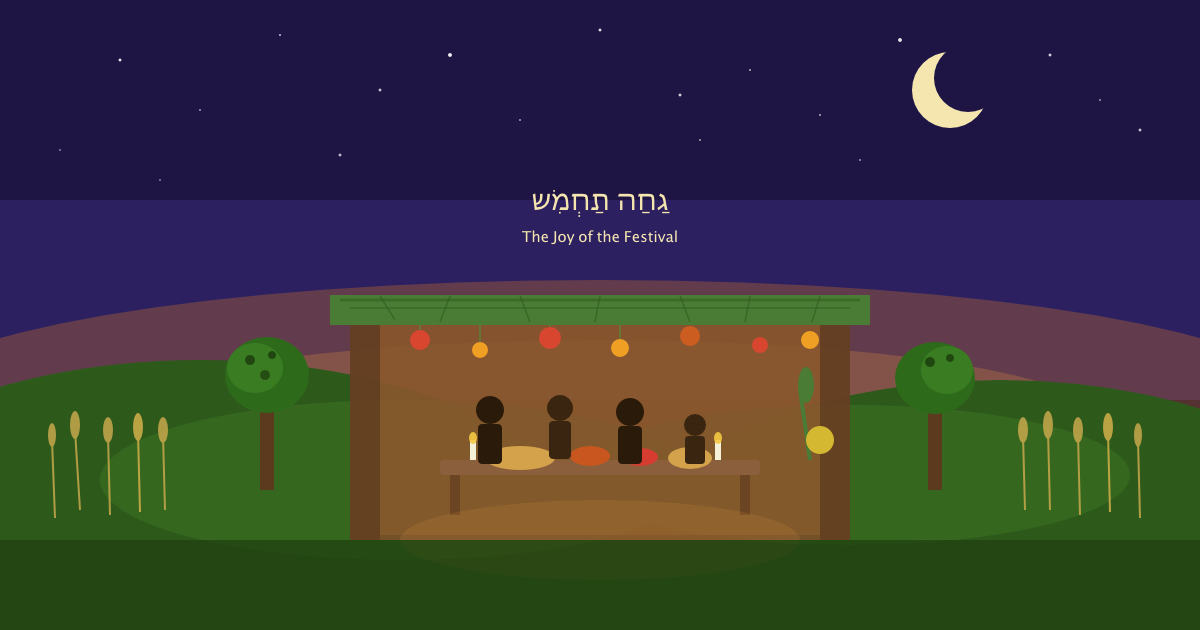
I'm not telling you any of this as an excuse to wallow in self-indulgent pity, but rather because it is the privations of my formative years that kept me alert to the precarious nature of our existence. While at the same time, the kindness of those who looked out for me even though they had nothing to gain by their actions helped me develop a sincere sense of gratitude. These are very much the themes of Sukkot - we are commanded to "…rejoice before the Lord your G-d with your son and daughter, your male and female slave, the Levite in your communities, and the stranger, the fatherless, and the widow in your midst…" - it's very inclusive. But we also celebrate by taking meals in a flimsy structure that is exposed to the rain - we welcome the vulnerability because we have spent the year trusting that G-d will provide for us, and at Sukkot we share the bounty we have been given. As it is written: "…offering your freewill contribution according as the Lord your G-d has blessed you".
Shavuot and Sukkot were important to our people in the First Aliyah at the turn of the last century. The reasons for that should be obvious - for the future Jewish state to survive we needed to make the desert bloom and the success of the agricultural cycle was literally a matter of life and death. I'll turn to my favourite High Holy Days book, Rabbi Alan Lew's "This is real and you are completely unprepared". He explains why Sukkot is the most joyful of the festivals - to quote Rabbi Lew:
"Perhaps this is because Sukkot is the holiday of the fall harvest. While we rejoice at Passover, it is not a full joy, because the spring seedlings are just beginning to come up, just beginning to break the plane of the earth, just beginning to show themselves in the world, and we don't know if they will make it to harvest or not. We rejoice at Shavuot, but it is only the early harvest, the time of the first fruits, and although there is a special joy in this, there is also anxiety. The full harvest won't be until fall, until Sukkot. But at Sukkot, there is no anxiety. There is nothing to hold back. There is only rejoicing. The full harvest has come."
— Rabbi Alan Lew, This is Real and You are Completely Unprepared
The Commandment to Rejoice
Rejoicing is an active commandment - the words on the Sanctuary wall are that we should "Serve the Lord with Joy". We mustn't confuse "joy" with enforced jollity, or even ritualised happiness. It should happen because Sukkot is the point in time and space at which joy is meant to happen and because our introspection and repentance during Yom Kippur calls out for catharsis - it should be the natural corollary, as CS Lewis put it: "Joy bursts in our lives when we go about doing the good at hand and not trying to manipulate things and times to achieve joy".
I'm going to leave you with my final though that Sukkot is the most Jewish of festivals. At Pesach, G-d freed us from slavery with "a mighty hand", to the point that the Egyptians drove us out - there was no way we were not leaving Egypt - our agency was limited. At Shavuot we were witness to the Divine revelation of the Ten Commandments - we certainly had to make a choice to accept them, but they were a gift that we had no part in forming. But at Sukkot it's mostly down to us - we have to turn up and bring our gifts and make sure that everybody is included in the rejoicing. By doing so we are all brought closer to G-d and we enjoy the literal fruits of our labour in the most joyful way possible.
Shabbat Shalom